
Devlog 1 | January 2026
First steps for The Reaping Company!
Welcome to the very first devlog of The Reaping Company, my first game as an independent studio under the name not!key.studio.
The objective of these monthly devlogs The goal is to document the game's progress, share design choices, successes, doubts, as well as technical and creative lessons learned. Eventually, these devlogs may also cover other projects, but for now, let's focus on this one.
This first month was mainly devoted to laying solid foundations, both creatively and technically.
Narrative research and writing
I began by establishing the narrative framework: the universe, the themes, the stakes and the overall direction of the narrative. The idea wasn't to write every line of dialogue, but of to build a solid structure to guide game design, level design and visual identity. Although I am not a professional writer, I want the story to be consistent., without resorting to convenient plot devices.
The central theme being death, My challenge is to find the right balance: to avoid melodrama without falling into excessive frivolity, in order to accurately serve my purpose. It was by validating this theme that I discovered two significant titles, which allowed me to refine my vision through comparison:
- Have a Nice Death by Magic Design Studios Despite a common premise (playing as a Grim Reaper in a corporate setting), the tone and gameplay are completely different from my project. It's an enjoyable game, even if it's not among my personal favorites. I learned a valuable lesson: while its animations are exemplary, the abundance of small, unclear gameplay systems is, in my opinion, a pitfall to avoid.
- Death's Door by Acid Nerve Absolutely stunning! This game quickly became one of my favorites thanks to its atmosphere, music, and tone. It taught me a lot, especially about managing secrets and storytelling. My only minor complaint, because I have to find one, is the lack of a map, which can be frustrating at the very end of the game, even though I understand and respect this design choice.
This research and analysis phase allowed me to define more precisely the tone of The Reaping Company and the place that the player will occupy within this universe.
Characters: sprites and prototypes
I hesitated a lot when choosing the artistic style. Initially, pixel art seemed like the obvious choice because of its relative simplicity (even though good pixel art is actually very demanding), and especially because of its speed of production.
Nevertheless, I explored other visual directions, including a more hand-drawn Inspired by Hollow Knight, with minimalist shapes and strong black outlines. However, applied to a full game project, and especially with the amount of animation I want to create, this approach wasn't viable for me.
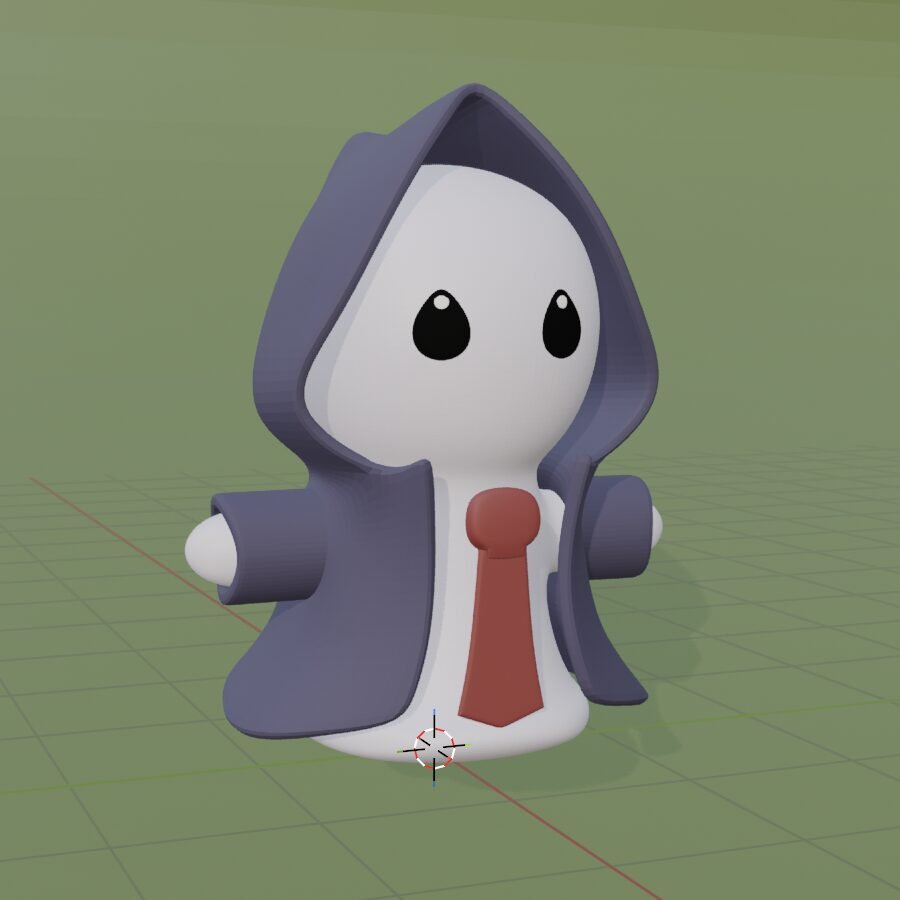
I also considered the 3D. Having studied this field for two years, my skills would have been perfectly suited to it. However, this would have considerably increased the project's complexity, particularly in terms of 3D rendering, and lengthened the production time. Here you can see a 3D prototype concept of the main character (the ghost), created with Blender.
So, for this first game, I decided to stay true to the initial idea: the pixel art !
I then created some sprites and prototypes for 5 main characters, with Aseprite, in order to quickly define their silhouettes, their personalities and their readability on screen.
I find real pleasure in working with pixel art, particularly in 16x16 resolution. This format demands extreme precision: every pixel must have its purpose. For me, the technical challenge often takes precedence over pure creativity, which perfectly suits my profile—more technical than creative. To improve, I immersed myself in the excellent... videos by AdamCYounis, whose talent and teaching methods are a true source of inspiration.
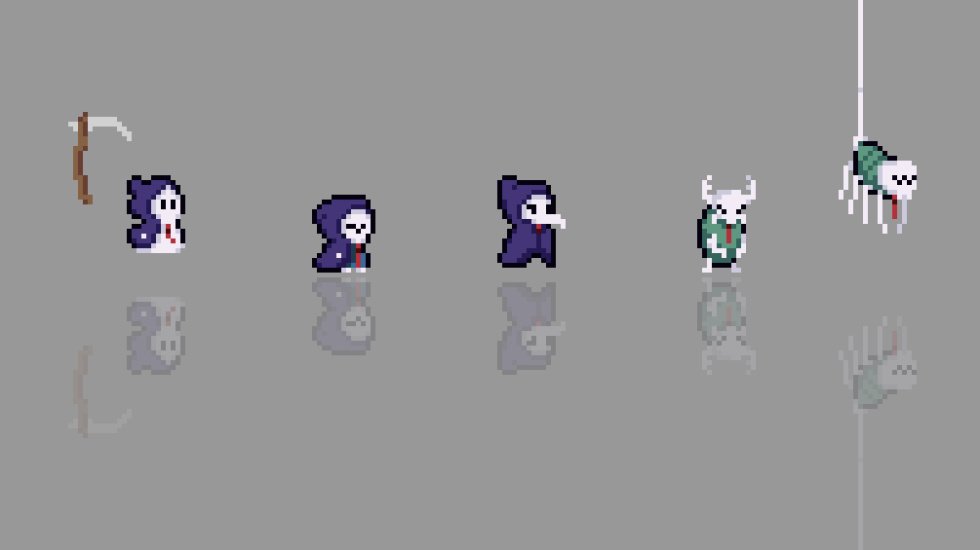
These versions are still under development and subject to change, but they already provide a basis for testing proportions, future animations, and overall artistic consistency.
Gameplay loop: put everything on paper
This first month was partly devoted to reflecting on the gameplay loop, the true heart of the game. As the days went by, I saw many ideas emerge to enrich the foundation I had imagined. My concept rests on three major pillars: time travel, alterations of reality, and the ghostly aspect of the character.
The goal is to integrate these mechanics into a genre that I particularly love: the Metroidvania, with a strong emphasis on action and storytelling. If I had to name my two major influences for the feel of the game, they would undoubtedly be Ori and Katana Zero.
Just as with storytelling, my priority is the consistency I want every gameplay mechanic to serve the narrative. To achieve this, I took the time to lay everything out on paper. I carefully considered how my ideas would fit together to ensure they would work in the long run without creating contradictions. After numerous iterations and adjustments, I believe I've found a solid theoretical balance that fulfills my objectives.
- A symbiosis between gameplay and story.
- A rewarding system for unlocking abilities.
- Satisfactory progress for the player.
- A coherent overall structure.
At a high level, the main loop will revolve around this three-part structure: Boss fight → Metroidvania-style exploration → Capacity building.
Each major victory will unlock new ways to explore the world and recontextualize previously visited areas. Of course, I suspect this structure will evolve once the initial elements are implemented, but for now… I won't say any more and prefer to keep some mystery!
Character illustrations
During my art direction tests, when I was working on a hand-drawn illustration style, I realized:
- An illustration of the main character (The Ghost)
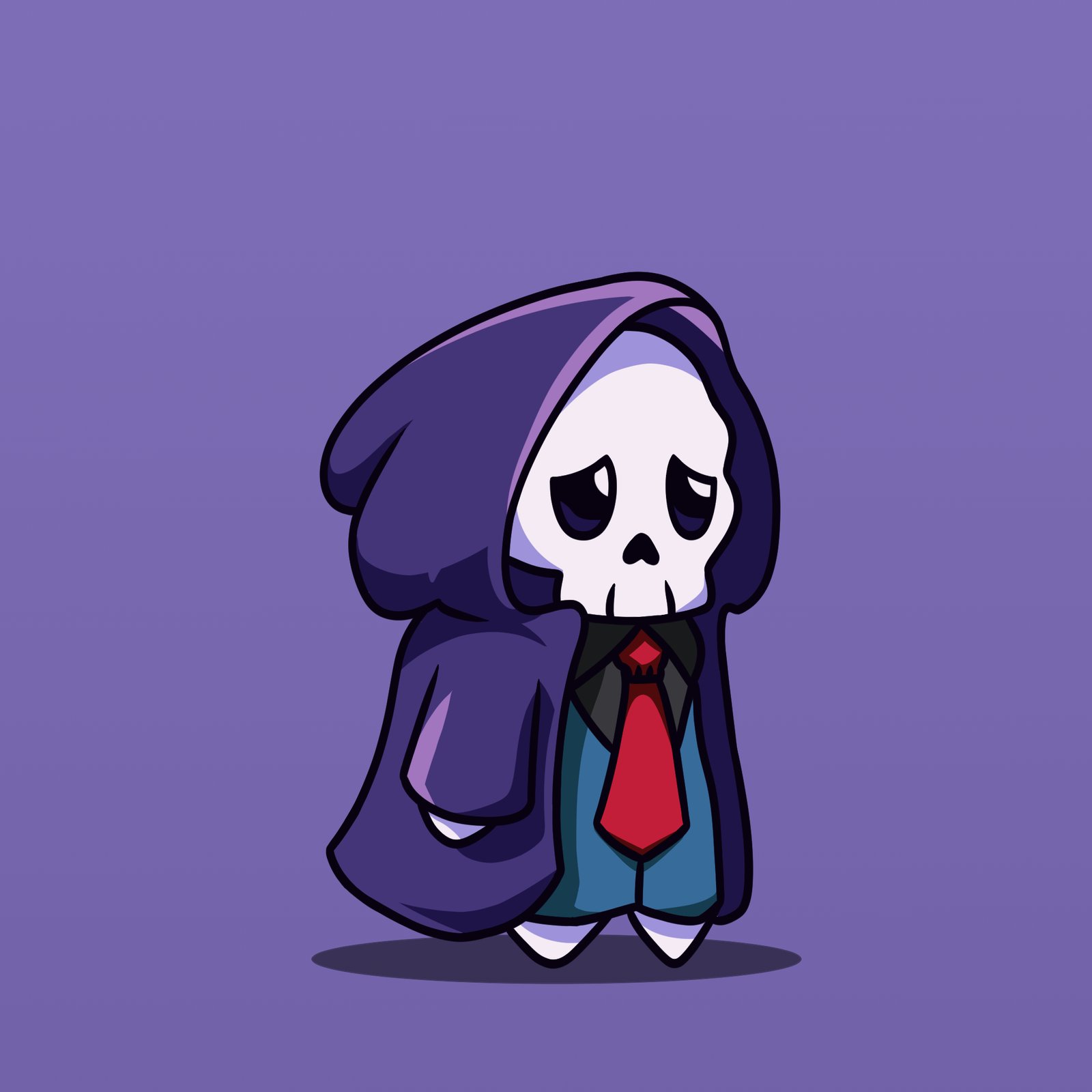
- An illustration of a secondary character (The Reaper)

The Ghost
The Reaper
I created these illustrations using a Wacom Cintiq 16 tablet (via Clip Studio PaintAnd since I'm not a professional illustrator at all, I had to go through five complete iterations before I was satisfied. In my illustration process, I start with a pencil sketch on paper before moving to digital, even if it means starting over several times if the result doesn't satisfy me when I come back to it a few days later.
Today, these visuals establish the art direction and will serve as the basis for future sprites and animations. This is also the style I might use for character portraits during dialogue sequences.
Learning Godot (with GDQuest)
Starting out in video game development is a huge challenge! Even though I have a background in web development and an artistic training, the video game ecosystem was completely new to me. Creating a game engine Since staying home wasn't an option for me, I needed to choose the ideal tool. But then, why did I choose Godot?
Today, three engines largely dominate the market: Unreal Engine, Unity and Godot.
Unreal Engine was initially my first choice. It's an extremely powerful engine that theoretically allows you to do everything without compromise. I had already used it for an animation project and taken several video training courses, including those of Cobra Code, specializing in 2D games. However, after testing 2D game development on Unreal Engine using Blueprints, I quickly realized how limited the engine was heavy and inert for a simple 2D project.
Yes, Unreal Engine can do everything, but at the cost of a significant complexity and a certain cumbersome nature. Simply launching the engine and loading a project takes time, and each system offers numerous variations and specific configurations. The engine is primarily designed for 3D (where it truly excels), but for simple 2D games, many features and effects must be disabled to function properly and avoid unnecessary resource waste. The conclusion was clear: the learning curve is steep, and for a graphically simple 2D project, the engine is too resource-intensive and unpleasant to use.
Concerning Unity, It's been used in many games I love, like Ori, Hollow Knight, and Death's Door. It's very popular, but also often criticized: sometimes poorly optimized, controversial economic decisions, and a level of complexity that isn't actually that far removed from Unreal Engine. I saw Unity as a kind of a good middle ground between Unreal and Godot, And since I didn't see any particular advantage in it compared to Unreal, I looked at Godot.
Godot, which I had initially underestimated and dismissed, has finally ticked all the boxes! The engine is open source, It's free, community-driven, and doesn't take any royalties in case of commercial success (unlike Unreal Engine and Unity). It's particularly well-suited to 2D games (while also supporting 3D), responsive, clear, very pleasant to use, and extremely fast to launch. The learning curve is quick, even though you have to learn a programming language (GDScript (In my case), it's very close to Python, a relatively accessible high-level language. The documentation is also excellent, which is a big advantage.
Once the engine choice was finalized, I began to learn Godot via the course « Learn 2D Gamedev » by GDQuest. I hesitated for a long time between this and video training, but I recommend this one without hesitation. The written format is, in my opinion (and this is subjective), a considerable advantage:
- We take more time to read and fully understand the concepts
- It is very easy to return to a specific module
- The trainer can go into great detail, sharing best practices, advice, and referring to essential resources.
Honestly, it's the best course I've ever taken. He does not just teach technical basics, he also conveys a professional and pragmatic approach to game development, from A to Z, in a progressive manner, with concrete and directly applicable examples.
Seriously, 10/10.
First building blocks of the game
After three weeks of learning, the desire to take action took over. I then began assembling the first building blocks of The Reaping Company on Godot:
- Basic controls : A character capable of moving and jumping.
- Game Feel Fine-tuning for movement, heavily inspired by the fluidity of Celeste's gameplay.
- Animations : About ten prototypes already integrated for the main character.
- Visual rendering : A low-resolution pixel art display coupled with a smooth (non-pixel-perfect) camera, a technical subject which, moreover, deserved its own dedicated article.
It's still a very basic start, but it's enough to get a feel for it. I can't wait to tackle the terrain and explore the next features!
To conclude
This first month was mainly devoted to construction: ideas, intentions, tools and first prototypes.
There is still a huge amount of work to be done, but the very first foundations are in place, and it is extremely motivating to finally begin to give concrete form to the project.
Thank you for reading this first devlog, and see you next month!